

Thank you for being part of the WEB project, delivering quality care to women and non-binary people experiencing domestic and family violence (DFV). Patients participating have completed surveys and those who have disclosed being afraid of a partner or ex-partner in the last 12 months have been asked to make a WEB appointment to discuss relationship issues with you.
To inform how you deliver care during the WEB appointment, we have developed this training and short video. We hope you find these resources useful
You will have access to a digital clinical decision support tool, the Healthy Relationships Tool, to support you with sensitively asking about DFV, providing a first line response which includes safety assessment and planning, and offering resources, ongoing supports and follow up appropriate to their safety risks. Eligible patients will also have the opportunity to be supported by a peer support worker, from a DFV service, who is a DFV survivor trained to support patients.
WEB Project

About the WEB Project
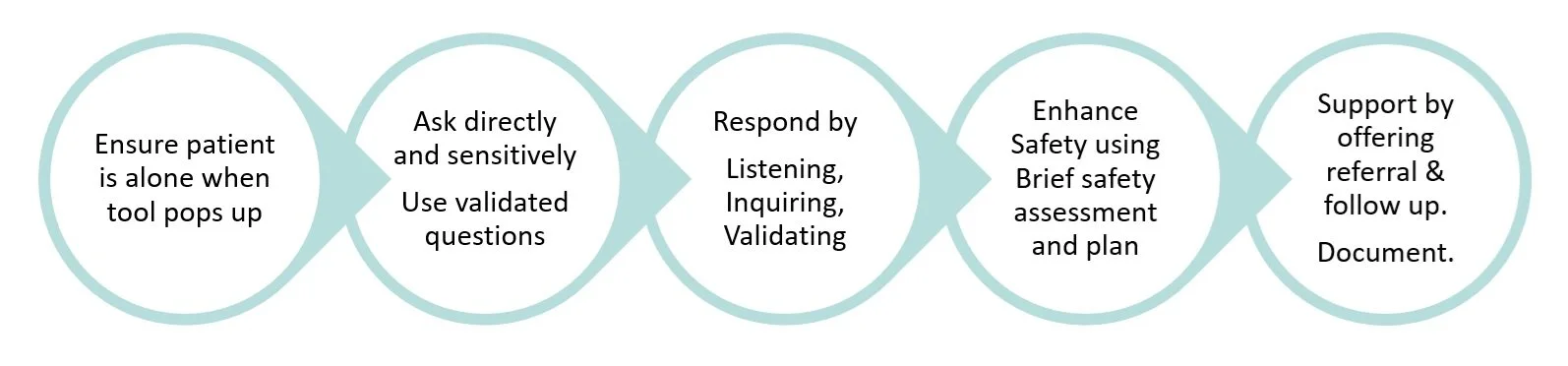
See the Safer Families 5 As guide for health practitioner conversations about DFV.
How to use the Healthy Relationship Tool

The boxes will not interfere with the EMR and can be:
Moved around on the screen by holding and dragging using your cursor
Minimised by clicking on the minimise icon (―)
Enlarged to fill the screen by clicking on the maximise icon (☐)
Closed at any time by clicking on the close icon (X)
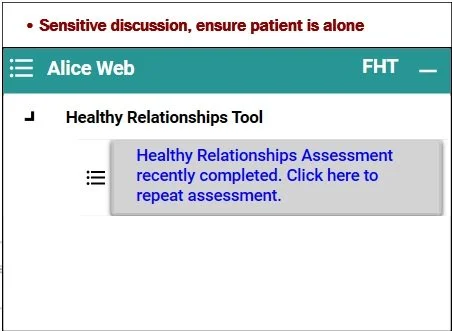
Opening box
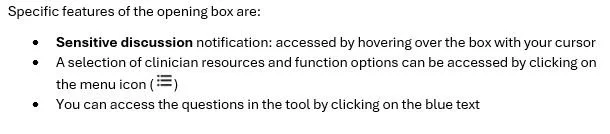
When you first open the patient record, you will notice the Healthy Relationships Tool automatically pop-up in the bottom right corner of your screen.
Sensitively asking using the tool – identification questions (ACTS)
After clicking on the opening box, the Healthy Relationships Tool supports you to ask about patient’s experiences of DFV. Studies show disclosure can be improved, and is acceptable to patients, by asking directly about experiences of DFV. The tool uses a validated set of questions (ACTS questions) to support you to ask about experiences of DFV. Following any disclosure, there are safety questions to identify immediate risk.
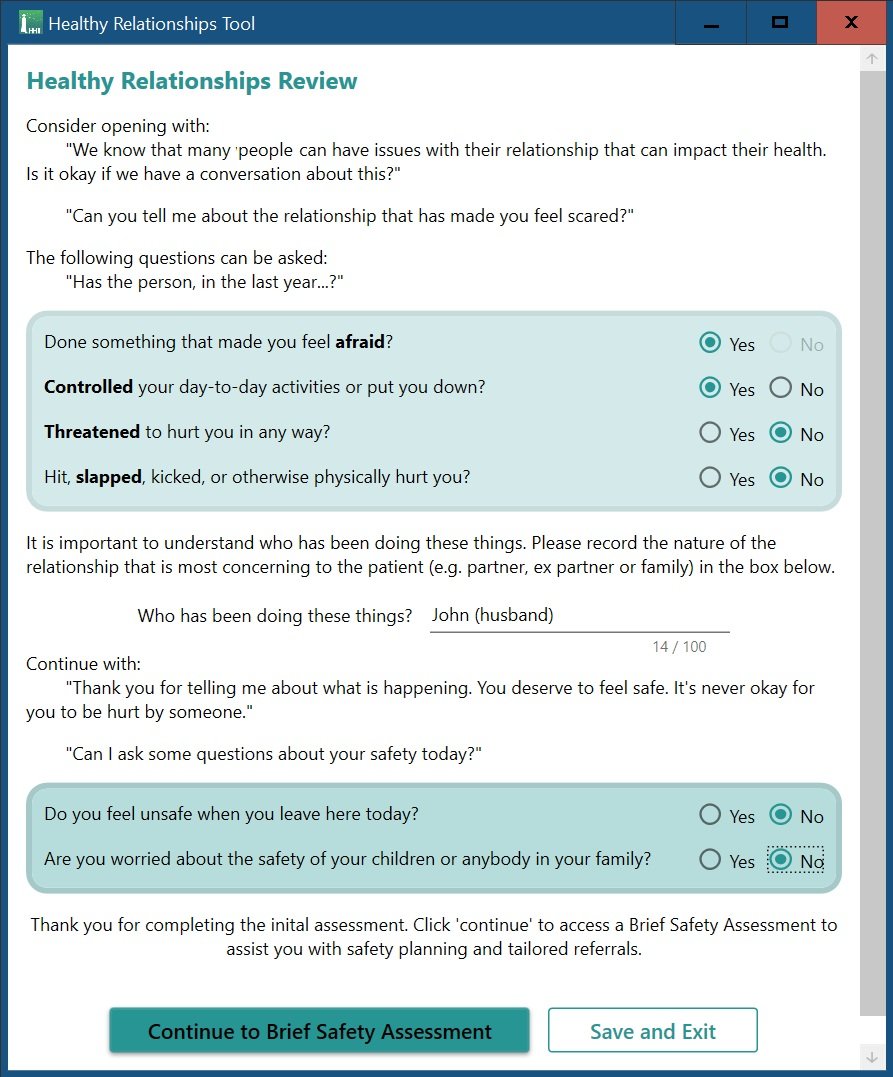
To proceed to the more detailed Brief Safety Assessment, all questions in this section must be answered. Doing this further assessment provides a list of resources and referrals through a Recommendations box, suited to the individual patient’s context and risk level.
Although we don’t recommend, if for some reason you would like to stop after the ACTS questions, you can save a record of questions answered, and access preliminary Recommendations (if all questions have been answered), by clicking on the “Save and Exit” button. If not all the questions have been answered, then using “Save and Exit” will result in the tool closing without any answers being saved, like using the exit button (X) at the top right of the box.
Respond to initial disclosures – using the LIVES model
The World Health Organisation has recommended the LIVES model to support response to DFV by health practitioners. (Listen, Inquire about needs, Validate, Enhance Safety, offer Support)
Listen and inquire about needs
Patients experiencing DFV will have different contexts and needs depending on their individual life circumstances. This may include needing to be listened to or referred for ongoing supportive counselling, or practical help with getting support for children, documentation or treatment for injuries.
The tool allows you to continue interacting with the EMR whilst it is active, meaning you can document important considerations after you’ve asked about the patient’s experiences and immediate safety.
The questions cover the following components:
About the person using domestic and family violence
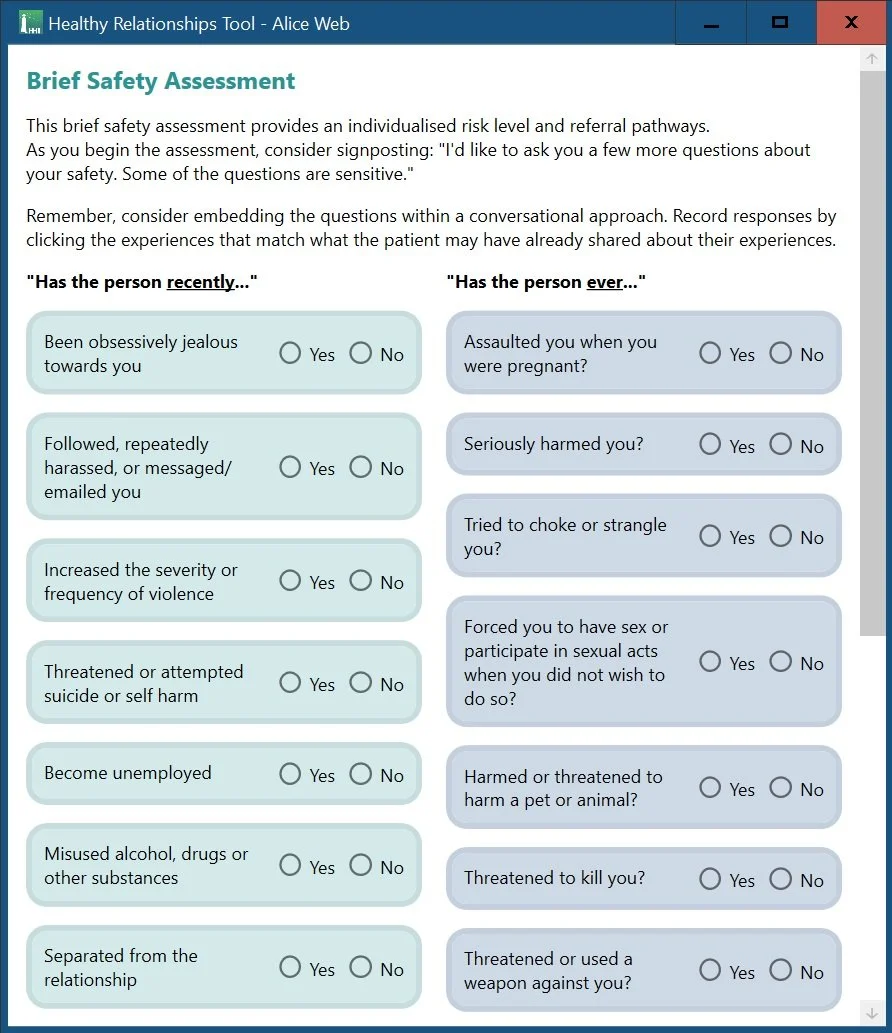
o Has any physical violence increased in severity or frequency in the last year?
o Recent risk behaviours (listed above)
About the survivor’s beliefs of the perpetrator’s capacity to kill or seriously harm her, her children, or other family members
About the children’s experiences of threat to harm or harm
The Healthy Relationships Tool includes a set of Brief Safety Assessment questions. It is important to recognise that some of these questions are sensitive, so proceeding at the patient’s pace is helpful to maintaining the rapport you have built throughout the consultation.
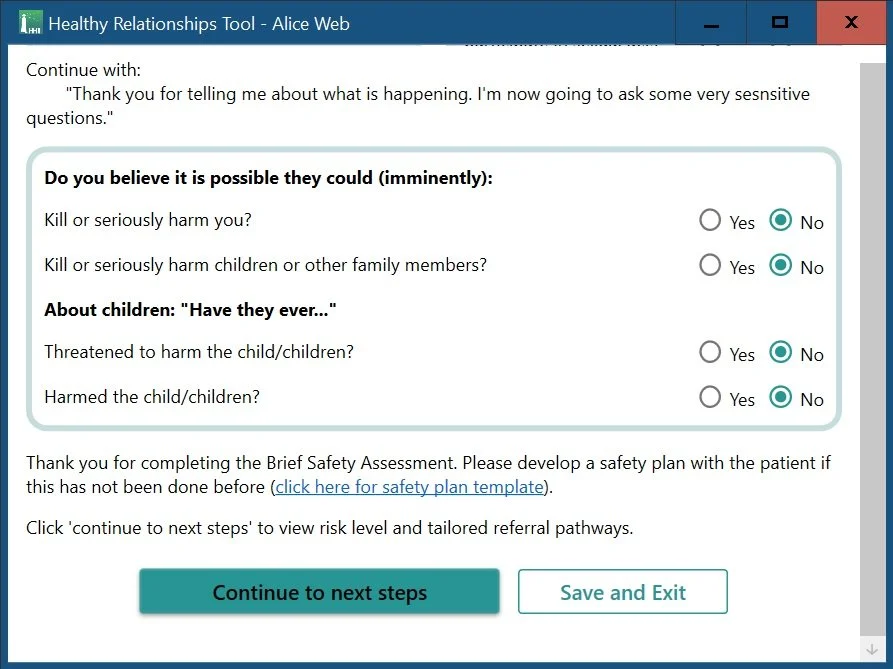
Proceed to the Recommendations by clicking on the “Continue to Next Steps” button, after answering all questions in the Brief Safety Assessment. Particularly, the questions about the patient’s belief of imminent harm to themself or their children influences the tailored risk assessment and recommendations.
If you would like to stop using the tool, you can save a record of the questions answered, and access the tool’s Recommendations, by clicking on the “Save and Exit” button.
Validate
You should affirm that violence is unacceptable behaviour and express support, before any other response. Even if an individual does not choose to pursue other interventions or engage with other agencies, your validation of their experience and the offer of support is an act that may in the long-run contribute to the individual being able to change their situation.
Examples of validating statements can be found on the Safer Families practitioner toolkit.
Using the tool to Enhance Safety – Safety assessment and planning
There are evidence-based risk factors for DFV harm. Many clinicians feel comfortable asking about these risk factors in a conversational style and it is important that assessment is followed by a safety plan if the patient doesn’t already have one in place. See Safer Families website.
In Victoria, the Multi Agency Risk Assessment and Management framework establishes a shared, evidence-based approach across sectors to increase safety and keep people who use DFV accountable. It incorporates a series of questions about the patient’s circumstances, the perpetrator(s) behaviour(s), and the children’s safety where relevant.
The Healthy Relationships Tool includes a set of Brief Safety Assessment questions. It is important to recognise that some of these questions are sensitive, so proceeding at the patient’s pace is helpful to maintaining the rapport you have built throughout the consultation.
The questions cover the following components:
About the person using domestic and family violence
o Has any physical violence increased in severity or frequency in the last year?
o Recent risk behaviours (listed above)
About the survivor’s beliefs of the perpetrator’s capacity to kill or seriously harm her, her children, or other family members
About the children’s experiences of threat to harm or harm
At this stage, it may be relevant to ask about children’s involvement and safety, and organise to review them, working collaboratively with the patient to do so in a safe manner. Consider local mandatory reporting guidelines and information sharing requirements. See the RACGP White Book or the Safer Families e-learning modules (Information Sharing module).
Proceed to the Recommendations by clicking on the “Continue to Next Steps” button, after answering all questions in the Brief Safety Assessment. Particularly, the questions about the patient’s belief of imminent harm to themself or their children influences the tailored risk assessment and recommendations.
If you would like to stop using the tool, you can save a record of the questions answered, and access the tool’s Recommendations, by clicking on the “Save and Exit” button.
Using the tool – Safety Planning and tailored Recommendations
Completing the Brief Safety Assessment questions will allow the Healthy Relationships Tool to define a ‘risk rating’ and delivers tailored Recommendations, resources and referral options. A conversation to align with the patient’s needs and wants will ensure they feel supported. Use professional judgement if the history, risk rating and intended next steps do not align for safety.
All patients should be offered to make a safety plan and it is advisable to offer a follow-up appointment with you. When detailing a safety plan, it is important to draw on survivor's expertise of keeping safe. Asking “What helps you to keep yourself and your children safe?” is one way to open this conversation.
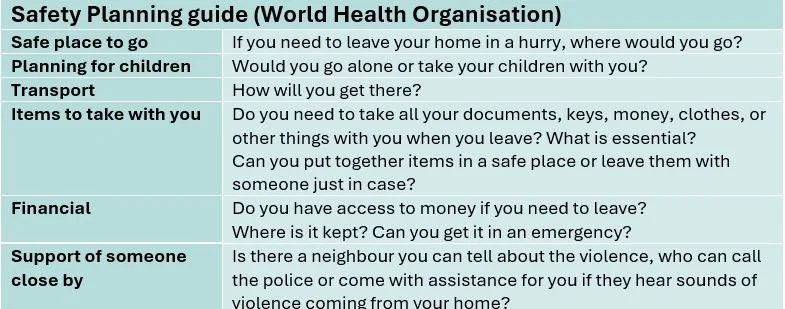
Some patients may like to write a plan down while others for safety reasons may not want to take a record home if there’s a risk it can be seen by the person using DFV.
Using the tool – Offering Support
For all patients it is advisable to offer a follow-up appointment with you in the clinic.
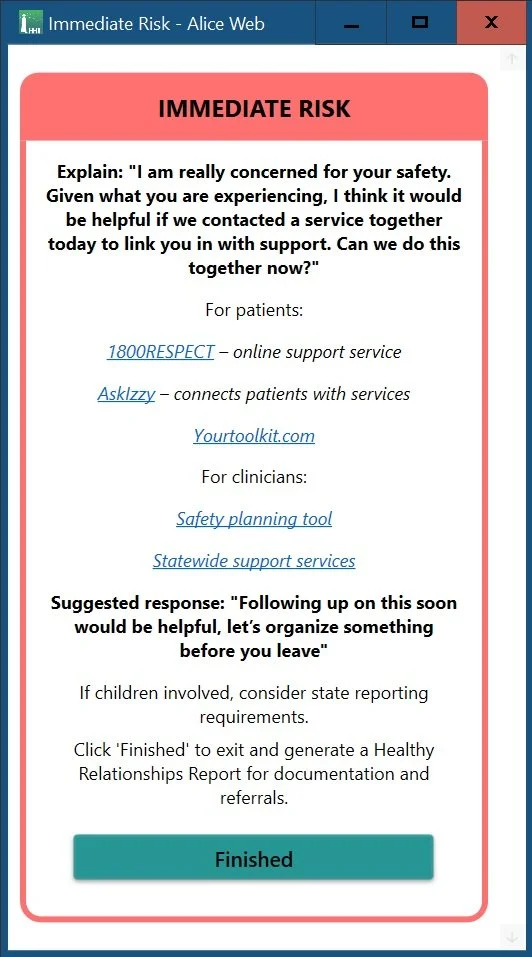
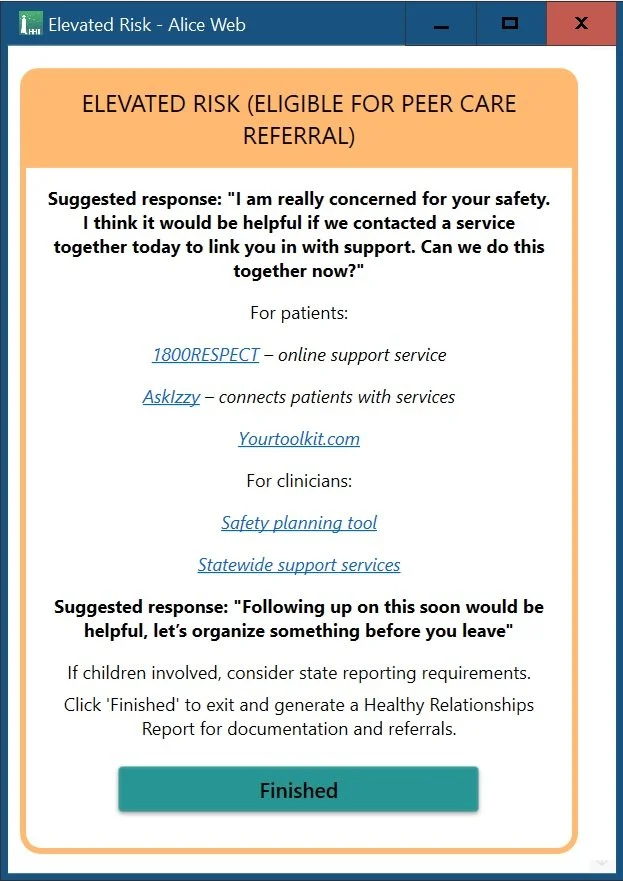
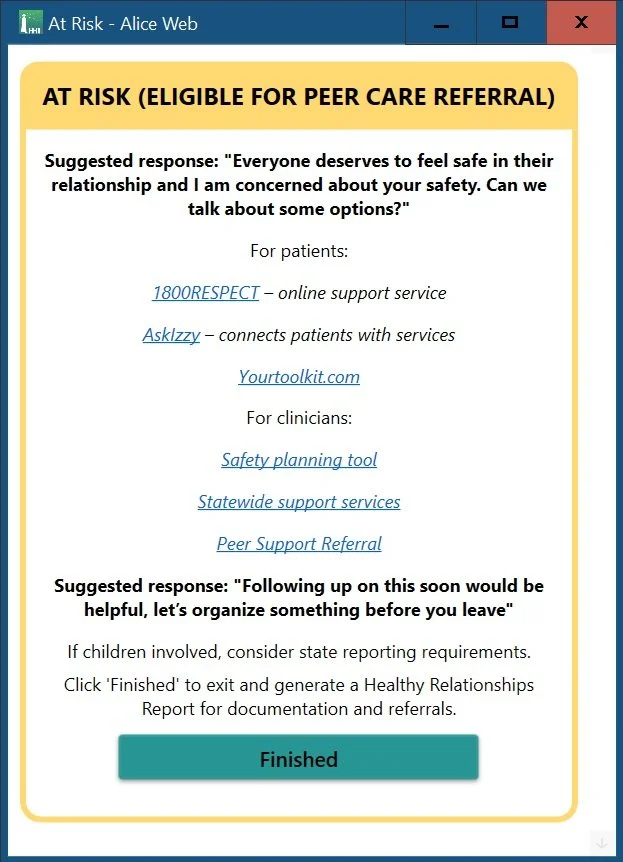
The recommendations given are tailored to the patient’s risk level and the resources are grouped:
Patient resources
Clinician resources
Peer care coordinator – for eligible patients in the WEB trial only
Specific features of Recommendations box:
The tool can be closed by clicking on the ‘Finished’ button. This will save a record of all questions answered in the tool, and the risk rating, and deliver a copy to your EMR inbox shortly after.
The links will take you to various national and state referral options, clinician and patient resources. Many of these have quick exits built in, however you may suggest the patient look over any resources in a private location.
Only eligible patients in the WEB trial can be referred to the peer support worker pathway. This will be covered in more detail in the section on Peer Care Coordinator Referrals.
Using the tool – Documentation and Referral
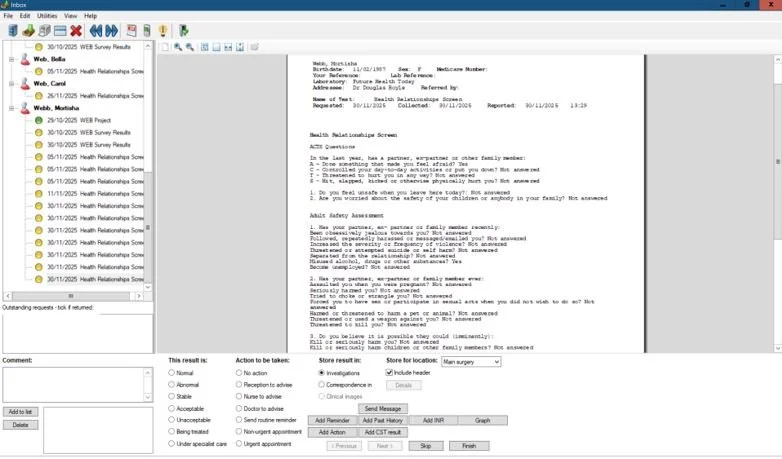
Documentation is another challenging factor that arises with disclosures of DFV, and with information sharing. To improve this process, you will be able to access the tool’s answers to use in your record keeping.
When the Healthy Relationships Tool is completed in its entirety, the software will generate a file that documents the questions answered, as well as the ‘risk rating’ at that consultation. This report will be delivered to your internal EMR system and eventually land in your EMR inbox. It has been deliberately designed such that you can save a copy in the notes, attach it to a template referral letter and add any text as required, particularly to detail the patient’s needs or safe contact details at referral.
Peer Care Coordinator Referrals
Eligible patients in the WEB trial can be offered to be referred to a Peer Support Worker. The Walking Beside program is designed to offer support to patients experiencing DFV. The referral is reviewed by the Peer Care Coordinator, an experienced DFV specialist, who then assigns a Peer Support Worker to the patient. The Peer Care Coordinator is available through the following services. Referrals must be made to the service that covers the patient’s current living address.
| Service name | Areas serviced | Contact |
|---|---|---|
| Women’s Health in the North (WHIN)/Berry Street | Melbourne’s northern suburbs including the cities of Hume, Merri-Bek, Nillumbik, Banyule, Whittlesea, Darebin, Yarra | Walkingbeside@whin.org.au |
| Gen West | Melbourne’s western regions including Brimbank, Hobsons Bay, Maribyrnong, Melbourne, Melton, Moonee Valley and Wyndham | walkingbeside@genwest.org.au |
A referral made to the Peer Care Coordinator must contain the following information (see template referral letter)
Patient’s preferred safe method of contact
Patient’s preferred safe time for contact
Does the patient require an interpreter for the service
Who has been using violence
Whether the patient is still living with the perpetrator or partner whom they are afraid of
Whether there are any children living with the patient
The Healthy Relationships Tool report
Further information on the role of the Peer Support Worker, and how to discuss this referral with an eligible patient, can be found on the WEB project site.
Suggested discussion of Peer Support Worker to patient
Prior to making the warm referral pre-empt the Peer Care Coordinator may not be available, determine patient’s availability for a return call so this detail can be included with any message left.
“Thanks for coming in today. Based on what you’ve shared, it sounds like you’re feeling fearful or controlled by X. I want you to acknowledge the courage it would have taken to recognise and talk about this – you’re not alone in this experience.”
“I’d like to offer you the opportunity to be part of a support program that’s currently being piloted across several clinics. It’s called the Walking Beside Program. It is designed to strengthen the way general practices like ours support patients whose family member is causing fear or harm.”
“If you choose to take part, you’ll be connected with a trained Peer Support Worker – someone who has lived experience of domestic and family violence, and who is now in a role to support other people. The sessions are flexible and centred around your priorities – whether that’s emotional support, finding services, or just having a safe space to talk.”
“This is a time-limited program because it’s part of a research trial to understand what supports are most helpful. Your feedback – only if you’re comfortable – will help shape how we build and improve services for others in future. But you don’t have to decide anything now, and there’s no pressure at all.”
“If you’re interested, I can try to introduce you to the program coordinator now or pass on your details so they can contact you safely in the next few days. Would you like to hear more about what that might look like?”
“Do you have any questions?”
Can you tell me what is the safest contact method that no one will have access to? I will write it down on the referral letter?